Thursday, April 22, 2010

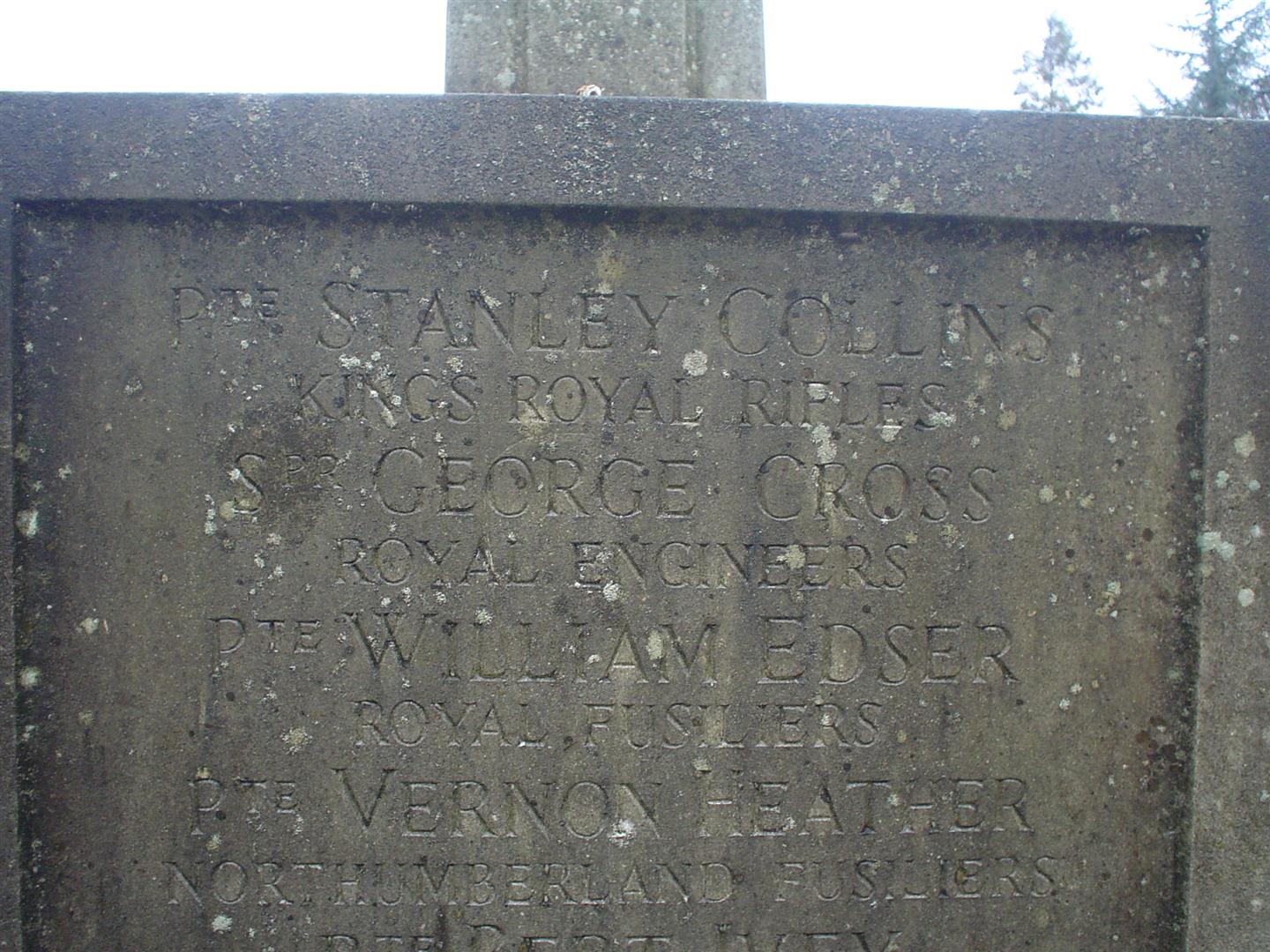
Stan Collins - Ockham War Memorial


I was in Surrey recently on a very wet and somewhat chilly day, and I took the opportunity to drive over to Ockham and photograph the war memorial there. Rifleman Stan Collins is commemorated on it, the first name on the panel to the right, as you face the front of the memorial.


Afterwards, I drove over to Ockham mill where Stan's father had once worked. The mill has been turned into exclusive properties these days and must be much changed from when Stan and his family lived there. I poresume that the family lived in the cottages to the left of the mill in the picture below.

Wednesday, April 07, 2010

Horace Martin


I received an intriguing e-mail - and photograph - from Canada recently.

Is the Horace Martin in this photograph, the same Horace Raymond Martin from Newick who served his King and Country with Princess Patricia’s Canadian Light Infantry? The man on the left bears a resemblance to the photo of Horace that I have, but I can't be sure. The photo was recently purchased in Washington State, about 300 miles south of the Canadian border.

The same photo has also been re-worked as a painting - SEE HERE - the artist maintaining that the photo was taken in east Texas. If this is the same Horace Martin from Sussex, he'd certainly travelled.

My thanks to Robert Stimmel for the intrigue.

Wednesday, February 03, 2010

Albert Henry Thompsett


I've just been sent a great photo of Albert Thompsett which must date to 1917 or 1918 and which was almost certainly taken whilst Albert was on leave in England. His mother stands nexr to him and possibly her mother is the lady seated. I'll be updating Albert's page shortly.


Wednesday, January 20, 2010

Wallace SIDNEY Mitchell

There's some additional information on Sidney Mitchell's page on the Chailey 1914-1918 site, thanks to a surviving - but badly water-damaged - service record in the WO 363 series. Sidney was a regular soldier who had joined the 3rd (Special Reserve) Battalion, Royal Sussex Regiment in June 1913, transferring shortly afterwards to the RGA as a regular soldier. He spent much of his time in Salonica, returning to England in March 1919 and then having a short-lived spell with the Military Foot Police in Dublin.

Interestingly, he also appears to have worked at Chailey Heritage at some point in time, presumably whilst he was also serving with the Special Reserve.

Saturday, January 09, 2010

The story of a hut - a photo dated


Yesterday, I posted a photo of Japanese nurses as Netley in 1914, and thanks to the backdrop in that photo I've been able to date another photograph in my collection (above). Click on it for a clearer picture.

For some reason known only to myself, I'd always assumed that this photo dated to later in the war. The background in this photo though, is almost identical (if not, actually, identical) to the Japanese nurses' photo. This means that it can only date to 1915. See the extract below, from the Tornoto Star of 13th January 1915.


The lady standing second from left on the back row is Frances Isabel Blencowe, a leading light with, and later commandant of, Sussex 54 VAD. The woman sitting third right on the front row is Emily Morris Marshall who would later take up the position of matron at Hickwells and Beechland House.

I'd be delighted if anybody can tell me anything about the ranks (for want of a better term) of any of the ladies pictured, and also what the ribbons on some of their tunics represent. In the meantime I need to update Frances Blencowe's page.

My thanks to Marika for the Toronto Star clipping which appears on the Great War Forum thread I mentioned yesterday.

UPDATE

Oh well, it was a good theory whilst it lasted - about eight hours. My thanks to Sue Light for insightful comments as ever - see comments below.

Friday, January 08, 2010

Netley's Japanese nurses


Francis Isabel Blencowe spent some of her VAD days at the Netley Military Hospital in Hampshire. Photos in her album depict Japanese nurses, and I've just come across a group photo of these ladies on an interesting thread on the Great War forum.

I'm reproducing that photo here, and my thanks to Marika in Canada for posting it on GWF. There is a follow-up to this photo which I'll post in a day or two.

Thursday, January 07, 2010

John Thomson Allan


I've been sent some intriguing information about John Thomson Allan who was a patient at Hickwells in 1915.

Frieda Gardhouse writes:

"John Thomson Allan lied about his age to get into the army after his father, a miner, got him a job in the mine. This lasted for three weeks as he hated it. My aunt, John's daughter, told me he has a South Africa medal, was in the Highland Light Infantry [and] Gordon Highlanders. She also mentioned the Boer War and gave me photos of him in his kilt, and with bagpipes."

By the time John Allan was at Hickwells he was serving with the 4th Gordon Highlanders and, if he was a Boer War veteran, must have re-enlisted as his Gordon's number dates to late November or early December 1914.

John Allan's medal index card courtesy of the National Archives.

Friday, December 25, 2009

Archie Capham


Further to my post on Wednesday, I've now been sent a photograph of Archie Capham with two of his children. My grateful thanks to Larry Cousins in Canada.

Wednesday, December 23, 2009

Archie John Capham

I've been contacted by Archie Capham's relatives in Canada and have therefore been able to correct and update his page on the Chailey 1914-1918 website. Archie was not a Chailey man, but he did spend time recuperating at Beechlands in 1918. Click Here to read about Archie Capham.

Saturday, November 21, 2009

Consciencious Objectors


This only relates to Chailey in as much when, several years ago on one of many visits to the National Newspaper Library at Colindale and trawling through old journals for information on Chailey during the First World War, I came across this snippet on consciencious objectors. I post it here now, for no other reason other than it's an interesting piece and also provides me with a great excuse to re-publish the Gilson cartoon above.

East Sussex News, Friday July 13th 1917

CONSCIENCIOUS OBJECTORS DUCKED
A party of consciencious objectors who had been sent to work in the New Forest had a hostile reception on arriving at Brockenhurst. Numbering about 60 they split into two parties… the former were pelted with clods of turf, booed and hustled out of the village, principally by civilians. The other party came in for rather rougher treatment. Two of their number were ducked in the stream at Balmer Lawn and their luggage which was on a lorry, was pitched into the river. Clods of earth were hurled at them. After a time they made their escape…

Find WW1 service records with a FREE 14 day trial to Ancestry.co.uk - Click here!

Thursday, November 19, 2009

Francis George Pettet

It's always great to find out additional information about Chailey's men and women, and the final release of records from the WO 363 series on-line via Ancestry has opened up the archive for people like me who live too far away from Kew.

Francis George Pettet appears as F Pettit and then F G Pettet in Chailey's parish magazine. Only two pages of his service record survive, but I've updated his page on the main Chailey 1914-1918 site.

Wednesday, November 11, 2009

11th November 2009

Remembering today, the men and women of Chailey who served their King and Country during two world wars, and remembering in particular, those who made the ultimate sacrifice.

At the going down of the sun, and in the morning, WE WILL REMEMBER THEM.

Friday, November 06, 2009

WW1 Service Records O-Z

Not before time, Ancestry has released the remaining 'Burnt Documents' and these are now searchable - after a struggle - on the Ancestry site. It's a pity, having waited so long for these, that Ancestry seems to have completely messed up the search function. Type the first name and surname in the relevant boxes and you'll just as likely get no results. Type the same names in the keywords boxes and the results appear.

Similarly, it's no use typing in the regiment (in the regiment box) and the name (in the keywords box) at the same time. That will also get you no results. Type the names first, wait for the results, and then narrow down by regiment. The information is there, it's just that Ancestry has messed up the search.

In any event, apart from finding my great grandfather's service records, I've also had a quick look at some of Chailey's men and found records for the following:

John Peckham
Francis George Pettet
Albert Still

There may be others, but in the meantime, I'll be updating these men's pages as and when.

Wednesday, October 28, 2009

Arthur Tully - a young Special Reservist

When Arthur Tully died of wounds in June 1918 he was 20 years old. And yet his number - LSR/2295 - dates to August 1914 and belongs to the series issued to the Royal Sussex Regiment Special Reserve - the 3rd Battalion. Of course, there was nothing unusual about men (or boys) joining up under age and Arthur appears to have fallen into that category. To be 20 years old in 1918 must have meant he was 16 in 1914 and was probably the reason he remained in England until 1917.

I'm guessing that his true age became apparent to the military authorities at some point and that he was retained in England until he became 19. If that was the case, it's unusual as I've seen countless service records of men who were discharged from the army having made a "mis-statement of age".

Arthur is buried at Varennes Military Cemetery in France. His headstone reads, PARTED ON EARTH / TO MEET IN HEAVEN.

Arthur Tully RIP

Tuesday, October 20, 2009

William Mainwood

I've updated William Mainwood's page with some more conjecture based on the two army numbers which were issued to him IF he was the same William Mainwood who served with the Royal Berkshire Regiment and the Ox and Bucks Light Infantry.

Thursday, October 08, 2009

Chailey Heritage 1928


My thanks to Roger Dougherty of Coneyhurst Paper Collectables for sending me the photo above. It shows Dr Charles William Kimmins and, presumably, boys from Chailey Heritage. It was taken in 1928. The biographies of Dr Kimmins's sons Anthony Martin Kimmins and Brian Charles Hannan Kimmins are on the Chailey 1914-1918 website.

Tuesday, October 06, 2009

Unveiling Chailey's war memorial


These images of the unveiling of Chailey's war memorial all date to the 2nd October 1920.

Thomas Deadman is clearly identifiable in some of the photographs but who are the other participants?


Even before the war was over, work began in Chailey to commemorate the dead of the parish.  A temporary war memorial, paid for parishioners, was unveiled in the summer of 1918.  The teak triptych made of wood from HMS Britannia can still be seen in St Peter’s Church, Chailey and is now situated above a memorial book. The triptych was unveiled on June 4th but a further eleven men from the village would die in action before the year was out.


News reached the village about mid day on the 11th November that the Armistice had been signed and the same evening, “a large and reverend congregation” filled the parish church to give thanks for the victory.  Services of thanksgiving were also held the following Sunday.


In June 1919, The Chailey Parish Magazine reported that at an adjourned public meeting held at The Reading Room, it was unanimously resolved to erect a granite war memorial designed by Mr Cotesworth, on which were to be recorded the names of those connected with the Parish who fell in the war. It was decided by a narrow majority of two votes that the location for the memorial should be opposite the Reading Room. (Photograph below courtesy of Mike Anton).


At peace celebrations held in the village on July 19th 1919 a Special Eucharist and service of thanksgiving was held, 114 soldiers and sailors attending a ‘sumptuous dinner’ in the Parish Room.  Children were presented with medals by Robert Blencowe to commemorate the end of the Great War and each child had his or her medal pinned to shirts and blouses.

The concluding toast paid tribute to the work of the Red Cross and especially mentioned Beechland House which had done such good work with Miss Cotesworth as Commandant.  Frances Blencowe was also singled out for praise.

The following year, on October 2nd 1920, Chailey's war memorial was unveiled.

Forty nine names of servicemen who were killed in action or died as a result of wounds or sickness attributable to the Great War appear on the war memorial on Chailey village green.  According to my research, the names of a further seven men should also appear.  In alphabetical order, they are:

Charles Buckwell (born and lived in Chailey), Charles Hodges (born in Chailey), Robert Charles Jessop (born in Chailey), William Alfred Lansdowne (resident in Chailey), Richard Roffe (resident in Chailey), Edward Wells (resident in Chailey) and Charles Jarrett Willey (born in Chailey).


In addition, Harold Macculloch certainly had connections with the parish (his father John died at home in Chailey in 1915) and his name appears on the wooden triptych inside the church and in the British Legion Roll of Honour but not on the war memorial.

Frederick James Smith and George Spencer Smith are both noted on the Commonwealth War Graves Commission’s Debt of Honour as being the sons of James and Margaret Emma Smith of Yew Tree Cottage, Cornwell's Bank, Chailey, Lewes, Sussex when in fact Colonel’s Bank is in Newick.  Their names appear on the war memorial in Newick along with those of two other brothers also killed during the First World War.

Finally, William Henry Spice is recorded on Soldiers in Died in The Great War as having been born in “Chailey, Kent”.  As I indicate on his page, this is certainly an error and it seems likely that he had no connection with the parish.

Wednesday, September 30, 2009

A V Martin


A V Martin - Albert Victor Martin

The other day, when remembering Chailey's men at Loos, I noticed that I hadn't added detail about Private A V Martin's army number. Army numbers can often tell you a lot about a soldier, which is why I've dedicated many hours to working on a separate Army Service Numbers project.

In A V Martin's case, his number L/10421, indicates that he joined up in August 1914 and joined as a career soldier with the Royal Sussex Regiment. That is to say, he joined up for a period of seven years with the Colours and five on the Reserve. We know this because that particular number sequence for the Royal Sussex Regiment was reserved for men who wished to enlist as career soldiers. Had Albert Martin joined up for war-time service only, his number would have been prefixed with SD/ (if he'd joined the 11th, 12th or 13th (the 1st, 2nd and 3rd South Down) battalions, and if the SD/ number series had reached as high as 10421 - which it didn't), or G/ if he'd joined another Royal Sussex Regiment service battalion.

The links I've given in the last paragraph will take you to posts that give more detail on numbering in these Royal Sussex Regiment battalions. Albert Padgham of Chailey (seated above) also joined the Royal Sussex Regiment under regular enlistment terms and you can read more about him by clicking on his name.

Friday, September 25, 2009

Loos - 25th September 1915


Remembering today, the men of Britain who took part in the Battle of Loos, and in particular John Oliver of Chailey who was killed on this day in 1915.

Today marks the 94th anniversary of the Battle of Loos and a number of Chailey's men were certainly involved in the fighting; amongst these Charles Bristow (2nd Royal Sussex), Albert Martin (2nd Royal Sussex) and John Oliver (10th Royal Sussex).

So too were soldier patients who would later recuperate at Hickwells on Cinder Hill; amongst these Edward Burnage (2nd Royal Sussex), William Chadwick (7th KOSB), John Currie (10th Gordon Highlanders), George Lucas (8th Royal West Kent), Arthur Reeve (8th KOSB), John Sheridan (12th Northumberland Fusiliers), James Sweeney (13th Royal Scots) and Horace Wood (8th Royal West Kent and pictured above, post 1916).

Tomorrow I'll look at another man with Chailey connections who was killed in action on the 26th September 1915. But in the meantime, today is the day to reflect and remember the 9,661 British soldiers who were killed in action or died of wounds on this black day in September 1915.

Also see today's WW1 Remembrance post.

At the going down of the sun, and in the morning, WE WILL REMEMBER THEM.

Friday, September 18, 2009

G/16155 John Wilfred Mitchell, 12th Royal Sussex Regiment


Chailey Parish Magazine first notes John Mitchell serving his King and Country in its March 1915 issue. In October 1915 it states, Mitchell, Lance-Corporal J, 2/4th Royal Sussex, England and in November 1916 updates this information to report that he is in France. This latter information is certainly incorrect as the 2/4th Battalion, formed at Horsham in January 1915, remained in England throughout the war until disbanded in November 1917. He probably went overseas as a 2/4th Battalion man and was posted, on arrival there, to the 1/4th Battalion.

John Mitchell appears to have served throughout the war, his name appearing up to and including the final published roll call in July 1919.  His medal index card notes two army numbers for him: 2170 and G/16155.

G/16155 belongs to a block of numbers issued to men who joined the Southdown battalions in France and John Mitchell's entry in the British War and Victory medal roll confirms that he was posted to the 12th battalion. Later on, he was posted again, this time to the 8th Battalion, Royal Sussex Regiment.

He is probably the same John Mitchell who was the fourth eldest child in a family of nine children (eight of them boys). His parents, Charles and Emily Mitchell, were married in 1880 and by the time the 1881 census was taken they were living at 1 Upper Birchland, Newick. Both were aged 22 with Charles (born in Lindfield) working as an agricultural labourer.

Ten years on, by the time the 1891 census was taken, Charles and Emily were living at what looks like Plummers Den Cottage No 1 in Lindfield and had five children: Charles Mitchell (aged nine), Henry J Mitchell (aged eight), Alfred Thomas Mitchell (aged six), John Mitchell (aged three) and Albert Basil Mitchell (aged eleven months).

By the time the 1901 census was taken the family was still living at the same Lindfield address but there were now more brothers – and a sister. New arrivals and their ages in 1901 were: Elsie Mitchell (aged seven), Walter Mitchell (aged five), Wallace Sidney Mitchell (aged four) and Maurice Gilbert Mitchell (aged nine months).

John Mitchell’s brothers Albert, Alfred, Henry, Wallace (Sidney) and Maurice, also served during the First World War. All of them survived. Their distant relatives, the Plummer brothers were less fortunate. Albert, Alexander and Owen Plummer all lost their lives.